
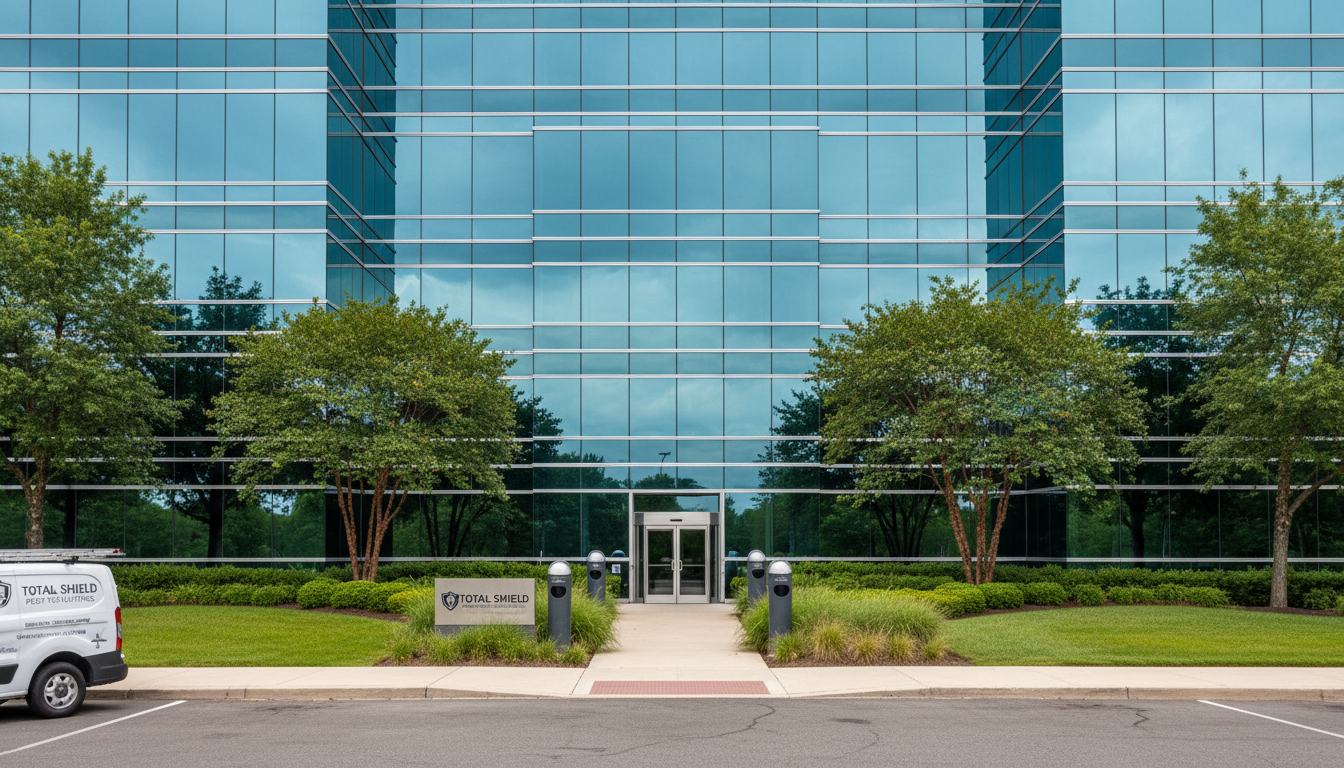
Trusted by NJ Property Managers & Business Owners
Fantwin Eco Pest Control provides specialized commercial pest management designed for the unique demands of business environments. Our Integrated Pest Management (IPM) approach minimizes chemical exposure while maximizing pest elimination effectiveness.
We understand that pest issues in commercial settings require speed, discretion, and thorough documentation. Our digital reporting system provides health inspector-ready documentation for every visit, treatment, and follow-up inspection.
Industries We Serve
Restaurants & Food Service
Health code compliance, kitchen sanitation programs, and discrete operations that won't disrupt your customers.
Office Buildings
Comprehensive interior and exterior management with minimal disruption to daily business operations.
Warehouses & Distribution
Large-scale rodent exclusion, inventory protection, and loading dock perimeter defense systems.
Schools & Education
Child-safe treatments with full documentation for administration and regulatory compliance.
Retail & Shopping
Discrete pest management that protects merchandise and maintains customer confidence.
HOAs & Apartment Complexes
Multi-unit coordination, common area protection, and fixed monthly contracts for property managers.
The Fantwin Commercial Advantage
Same-Day Emergency Response
24/7 emergency service for critical pest situations that threaten operations.
Digital Documentation
Detailed digital reports for health inspectors, auditors, and corporate compliance.
Discrete Operations
Professional, uniformed technicians trained to operate discreetly during business hours.
Fixed Monthly Contracts
Predictable budgeting with comprehensive monthly protection plans and no surprise charges.
Full NJ Licensing
NJ Commercial Pesticide Applicator License #65189B with all required certifications.
Property Manager Support
Dedicated account management for HOAs, property managers, and real estate investors.
Commercial rodent work, and where a contract earns its keep
Most commercial pest contracts in South Jersey are decided on rodents. Insects are seasonal and usually visible; mice and rats are year-round, they arrive through the building rather than through the door, and they are the finding that closes a kitchen or fails an audit. A commercial rodent program is not a monthly spray. It is a fixed set of places checked in the same order every visit and written down, so that a change in the building shows up as a change in the record rather than as a phone call from a customer.
Exterior perimeter and refuse areas
Dumpster pads, grease containers, baled cardboard and the vegetation line behind them. Rats live outside and commute in, so an interior-only program treats the symptom on a schedule and never reaches the source. Exterior stations go where the runway already is — along walls, fence lines and harborage edges — not spaced evenly for the sake of a tidy map.
Loading docks and overhead doors
Dock levelers, door sweeps, the gap under a roll-up where the seal has been crushed by a pallet jack, and the corner where a dock bumper has pulled away from the wall. On a warehouse this is usually the whole rodent problem, and the fix is a repair rather than a treatment.
Kitchen lines, prep areas and dry storage
Under and behind the cook line, the void behind the dish machine, motor housings on refrigeration, the underside of prep tables and the first two feet of every dry-goods shelf. German cockroach and mouse pressure share the same harborage in a commercial kitchen, which is why they are inspected together instead of on separate visits.
Shared walls, chases and utility penetrations
In multi-unit housing a mouse does not respect a lease line. Plumbing chases, electrical penetrations, HVAC line sets and the gap where a slab meets a block wall move mice between units, so treating one apartment in an occupied building is a callback in six weeks rather than a result.
Monitoring between visits
Interior monitoring placed where activity would appear first, checked and recorded every visit. The value is not the catch. It is knowing on the twelfth of the month that something changed, instead of finding out on the morning an inspector opens a cabinet.
Exclusion and repair, written down
Every visit that finds an entry point records it with the material that will actually hold it — sealed metal, hardware cloth or mortar at a rodent entry, not expanding foam on its own. Work Fantwin performs is documented, and so is work that belongs to your contractor or landlord, so the file shows what was recommended and on what date.
How a commercial account starts
There is no proposal without a walkthrough. Commercial buildings differ too much for a price list to mean anything, and a figure quoted over the phone is a figure that changes on the first visit. The walkthrough is short, it is free, and it is scheduled around your hours.
- 1Walk the property with whoever actually opens the doors — the general manager, the chef, the superintendent. They already know where the problem is, and they are the reason the second visit is faster than the first.
- 2Findings in writing: what was seen, where it was seen, and what the building is doing to cause it. Conditions that belong to maintenance are named as maintenance rather than folded into a pest charge.
- 3A scope and schedule agreed in writing before any work — areas covered, visit frequency, what triggers an additional visit at no extra charge, and what is quoted separately.
- 4First service, run around your operating hours rather than ours, with access and alarm arrangements settled in advance.
- 5Documentation filed after every visit, in a form that can be handed to a health inspector, an auditor or a corporate compliance file as it is.
- 6A review at agreed intervals. A program that never changes is a program nobody is reading, and a building that has been sealed properly should need less over time, not the same forever.
What is in the report after every visit
Documentation is the part of a commercial contract that gets tested, and it is usually tested on a morning when someone is already standing in the building asking for it. The report is written to be handed over unedited.
- Date, arrival and departure times, and the technician who performed the service.
- Every area inspected, including the areas where nothing was found — an inspector can only read absence as evidence if it was recorded.
- Devices serviced, their locations, and what each one showed since the previous visit.
- Any product applied, with the product name, the EPA registration number, the target pest, the amount and the specific location treated.
- Conditions driving the pressure — sanitation, moisture, storage practice, structural gaps — stated plainly and assigned to whoever is able to correct them.
- Corrective actions recommended, with previously recommended items marked as completed or still open.
Scope, licensing and what is quoted separately
Fantwin Eco Pest Control is a licensed New Jersey commercial pesticide applicator operating under License #65189B. The certification categories held and the current expiration date are published on the FAQ page rather than repeated across the site, so there is one place to check them and one place to correct them.
Pesticide application is New Jersey work only. In Pennsylvania the scope is exclusion and repair only — sealing entry points, dock and door work, screening and proofing — with no pesticide applied there while reciprocity is pending. A management company with buildings on both sides of the river should expect a different scope on each, stated at the walkthrough rather than discovered on a service day.
Commercial pricing is quoted per contract, after the walkthrough, and that is the honest reason there is no figure on this page. Square footage, food handling, dock exposure, unit count, the condition of the building and how often it needs a visit move the number far more than the pest does. Residential figures published elsewhere on this site are for single-family homes and do not carry over to a restaurant, a warehouse or a forty-unit building.
Termite and wood-destroying insect work is a separate scope with its own inspection, its own report and its own quote. It is not folded into a general commercial program, because a monthly pest figure that quietly contains a termite job hides what is actually being paid for.
The commercial services behind these programs
Rodent control
Mice and rats around loading docks, kitchen lines, refuse areas and shared walls in multi-unit buildings — inspection, treatment and structural exclusion.
Commercial pest control
The full commercial program page: scope, documentation, scheduling around operating hours, and what a monthly contract covers.
Cockroach control
German cockroach pressure in commercial kitchens, break rooms and food-storage areas, where sanitation and harborage drive the result.
General pest control
Routine interior and exterior coverage for offices, retail floors and common areas between specialist visits.
Commercial questions we are asked before a contract is signed
- Can you service the building outside our operating hours?
- Yes. Commercial visits are scheduled around your hours, including before opening and after close. Raise it at the walkthrough: access, alarm arrangements and who lets the technician in are the three things that derail a commercial schedule, and all three are easier to settle before the first visit than after a missed one.
- Will we get documentation a health inspector will accept?
- Every visit produces a written report covering the areas inspected, the devices serviced, any product applied with its EPA registration number and treated location, the conditions found, and the corrective actions recommended. It is filed digitally so it can be produced on the day it is asked for rather than reconstructed from memory afterwards.
- How quickly can someone get here when something goes wrong in front of customers?
- Emergency response is same-day for situations that threaten operations — a rodent seen in a dining room, live activity found during a pre-inspection, a failed audit item that has to be closed out. Call the number on this page and say it is a commercial account, because that call is triaged differently from a routine appointment.
- Do you cover multi-unit residential — apartment buildings, HOAs and management companies?
- Yes, and in Camden County it is the largest share of commercial rodent work. Multi-unit properties are inspected as one structure rather than as a list of units, because mice travel through shared walls, chases and utility penetrations. Common areas, basements, trash rooms and the exterior perimeter sit on the contract; unit interiors are scheduled as access allows, which is a coordination problem more than a pest problem and is planned for accordingly.
- What does a commercial contract cost?
- It is quoted after the walkthrough, and the walkthrough is the reason there is no number here. A fixed monthly figure is agreed in writing before any work starts, so the amount budgeted is the amount billed. Anything outside that scope is quoted separately and in advance rather than appearing on an invoice.
- Can you provide a certificate of insurance naming our company?
- Yes. Ask at the walkthrough or when the contract is prepared, and the certificate is issued by our insurance agent listing the coverage in force. Vendor packets, W-9 requests and management company portals are routine and are handled at the same time rather than after the first invoice is queried.
- Do you cover commercial properties in Pennsylvania?
- In Pennsylvania the scope is exclusion and repair only — a building there can be sealed, screened and structurally repaired, and no pesticide is applied while reciprocity is pending. It is said up front and put in writing, because a property manager who discovers it on a service day has already lost a morning.
- Do you remove birds, squirrels, raccoons or bats from our building?
- No. Fantwin is licensed for structural pest control — mice and rats — and does not hold a wildlife control permit, so we do not trap, remove, or relocate wildlife. If the activity at your property turns out to be a wild animal rather than a rodent, we will tell you at the inspection and refer you to a licensed wildlife-control operator. We would rather say so than sell you the wrong visit.
- Do you handle termites and wood-destroying insects on a commercial property?
- Yes, under the New Jersey 7B category, and it is quoted separately from a general commercial program. A wood-destroying insect inspection has its own scope, its own report and its own price. Real estate transactions and lender-required inspections are handled the same way.