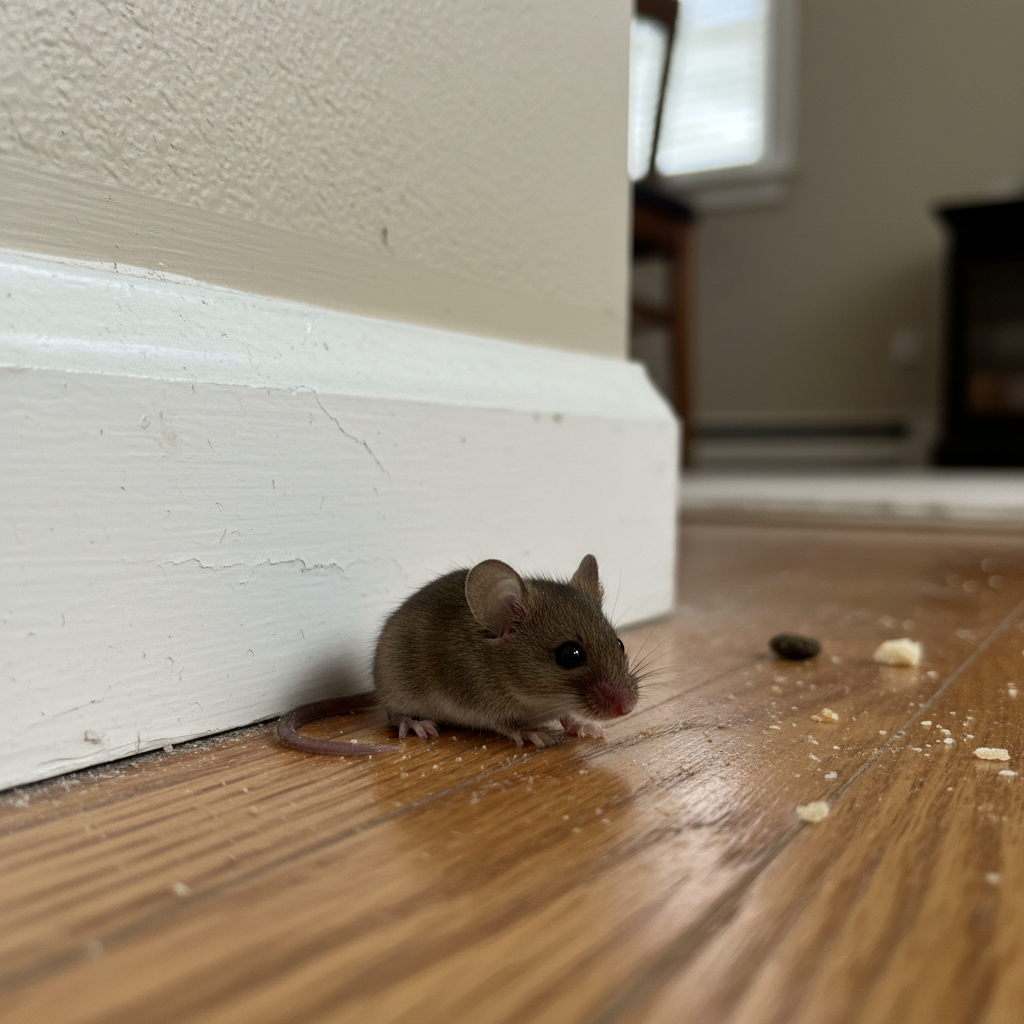
Marlton sits inside Evesham Township (ZIP 08053), where wooded edges, attached garages, and Route 70 townhome communities create predictable mouse highways every fall. If you only set traps without sealing entry points, new rodents replace the ones you catch.
This guide is written to be done rather than just read. Everything below is something you can check yourself on a dry afternoon with a flashlight, a pencil and about twenty minutes. Knowing where your own house is open is worth having whether you close the gaps yourself or hand the list to someone else.
Start with the house you actually have
Evesham Township housing stock falls into a few repeating shapes, and each one leaks in a different place. Split-levels and 1970s colonials off Greentree Road usually pair an attached garage on the front elevation with a low block foundation, so their weak points sit at ground level: the garage, the line where block meets framing, and the hose bibb. Newer vinyl-sided homes hide their gaps behind trim, because J-channel, corner boards and the strip under the first course of siding are all continuous voids when the ends are left open. Brick-front homes have weep holes by design, and a weep hole is mouse-sized.
Townhome and twin rows near Route 70 add one thing a detached house does not have: shared structure. A party wall, attic space continuing above the ceiling line and a common utility chase mean a mouse in your neighbor's kitchen has a covered, heated route to yours without going back outside. If a neighbor mentions activity, treat your own walk-around as urgent rather than optional.
Garage doors and weather seals
A quarter-inch gap under a garage door is enough for a mouse. Marlton homes with older bottom seals or warped panels are frequent entry points — especially where the garage connects to laundry or mud rooms.
You can test this in daylight with no tools at all. Close the door, stand inside the garage with the lights off, and look along the bottom edge. Any daylight you can see is a gap a mouse can use. Check the two bottom corners hardest: the seal is crushed flat there every time the door closes, so corners fail years before the middle does, and a small triangle of light at a corner is one of the most common openings on a Marlton home.
- The bottom seal, and above all the two bottom corners where it is compressed flat
- The vertical gap between the door track and the block or slab on each side
- The threshold of the garage service door — the same corner problem in miniature
- The gap where the garage back wall meets the house, often left open above the ceiling drywall
- Whatever is stored against that back wall: cardboard, birdseed, pet food and grass seed turn a gap into a reason
Utility penetrations and AC lines
Cable, gas, and AC line openings through siding or foundation often have foam that rodents chew through. Steel wool plus appropriate sealant (or professional exclusion materials) lasts longer than expanding foam alone.
The reliable way to find all of them is to stop hunting for holes and start counting services. Every utility reaching your house had to come through a wall, and whoever brought it through cut the opening. Walk the full perimeter once, slowly, staying below waist height, and put a hand on each one.
- Electric service entry, plus every exterior outlet and light box
- Gas line, water line and the outdoor hose bibb
- Cable, phone and fiber — often the worst, because they are retrofitted through finished siding
- The AC line set where it enters the wall, and the condensate drain beside it
- The dryer vent, the bathroom fan outlet in the soffit and the kitchen exhaust
- Sump discharge, radon pipe, and any abandoned pipe nobody removed
Then read what you find. An opening finished on purpose looks cut and filled flush. An opening in use looks disturbed at the edges: expanding foam that has been chewed is shredded and crumbly rather than sliced, insulation is pulled out in strands, and there is often a faint dark smear on the siding just below it where oil from their coats has rubbed off. If a pencil slides into the gap beside a pipe, a mouse can follow it.
Deck ledgers and crawl vents
Raised decks and screened vents near Greentree and Kresson Road properties can hide runways. Look for rub marks, droppings, and nesting material in insulation.
A deck is attractive for the same reasons a porch is: dry, covered, and nobody walks under it. Get low at the open end with a flashlight held almost flat to the ground — raking light throws a shadow that straight-on light washes out — and look along the foundation for a narrow lane of packed mulch or worn soil, an inch or two wide, running parallel to the wall. That lane is a runway, and a runway ends somewhere. Follow it to the end and you have usually found the entry point without touching anything. Check crawl-space vent screens at their corners rather than the middle, because the corner is where the frame separates.
Reading what you find: active, or old?
Most homeowners find evidence and cannot tell whether it is from last night or last winter — which is the whole difference between a problem and a memory. The tests are simple and you already own everything they need.
- Droppings: mouse droppings are about the size of a grain of rice with pointed ends, rat droppings noticeably larger and blunter. Fresh ones are dark, slightly glossy and soft enough to squash; old ones are dull, gray, dusty and crumble under pressure.
- Rub marks: a dark greasy line along a wall roughly an inch off the floor, darkest where it rounds a corner or squeezes past a pipe. A mark like that takes many trips to build, so a strong one means a route in regular use.
- Gnaw marks: freshly gnawed wood is pale with sharp edges; weathered gnawing is gray and rounded. Chewed plastic and cable sheathing are the version to photograph and take seriously.
- Sound: scratching that starts within an hour of the house going quiet at night tells you more than anything you will see in daylight.
If you want certainty, dust a light film of plain flour or talc across a suspected run — along a basement sill, under a sink, across the garage threshold — and look again the next morning. Tracks or a drag line through the dust settle the question in one night and cost nothing. Photograph whatever you find with something in frame for scale; that is far more useful to an inspector than a description.
The openings a perimeter walk will never show you
Walking the outside finds the way in. It does not find the way through, and in most homes the reason a mouse turns up in a second-floor bedroom is a vertical void rather than a second hole. Once the exterior is done, check these from the inside.
- Under the kitchen sink and behind the dishwasher, where supply lines and the drain come up through the cabinet floor
- The cabinet toe-kick, and the chase behind kitchen soffits that often runs unbroken to the ceiling
- Behind the washer and dryer, at the vent and standpipe penetrations
- The basement or crawl ceiling where pipes and wiring pass up into the wall bays
- Where the stair stringer meets the foundation wall, and the space behind a finished basement's furred-out wall
- The garage ceiling where it meets the shared house wall, and the attic directly above it
- Around a fireplace chase, and any recessed light or bath fan cut into the top-floor ceiling
What is not worth your Saturday
Being straight about what does not work saves more time than any tip. Expanding foam on its own is a marker, not a seal — rodents chew through it, and a foamed hole often reopens within a season. Steel wool packed in with nothing over it rusts, sags and drops out. Ultrasonic plug-in repellers have not held up when tested, and neither peppermint oil nor dryer sheets will move a population that already has food, warmth and a nest. Shelf-bought poison pushed into a wall void has a failure mode worth knowing: it works, the animal dies where you cannot reach it, and you live with the odor for weeks. None of those close the opening, and closing the opening is the only step that ends the cycle.
When to stop looking and book an inspection
Do the walk yourself first. You will find things, and a written list of what you found makes any later visit faster. Bring someone in when the evidence turns up in more than one room, when you are hearing activity above a ceiling rather than at floor level, when droppings are clearly bigger than rice grains, or when you have sealed everything you can reach and activity carries on. All four point the same way: there is a route you cannot see from where you are standing.
What Fantwin does differently
Our rodent program emphasizes exclusion and monitoring — not leaving poison in family living spaces as a first resort. Start with a Marlton/Evesham inspection from our local service page, then choose a recurring plan if pressure returns each season.
Call 908-844-8650 or request a quote for Marlton rodent exclusion. Related reading: mosquito prevention for Marlton backyards and our Marlton pest control hub.